What is a sandwich ELISA?
Sandwich ELISA is a highly sensitive method used to measure specific proteins or peptides in samples such as cell culture supernatants, plasma, or serum.
How it works:
1. A capture antibody, attached to a plate, specifically binds the target protein.
2. The sample is added, allowing the 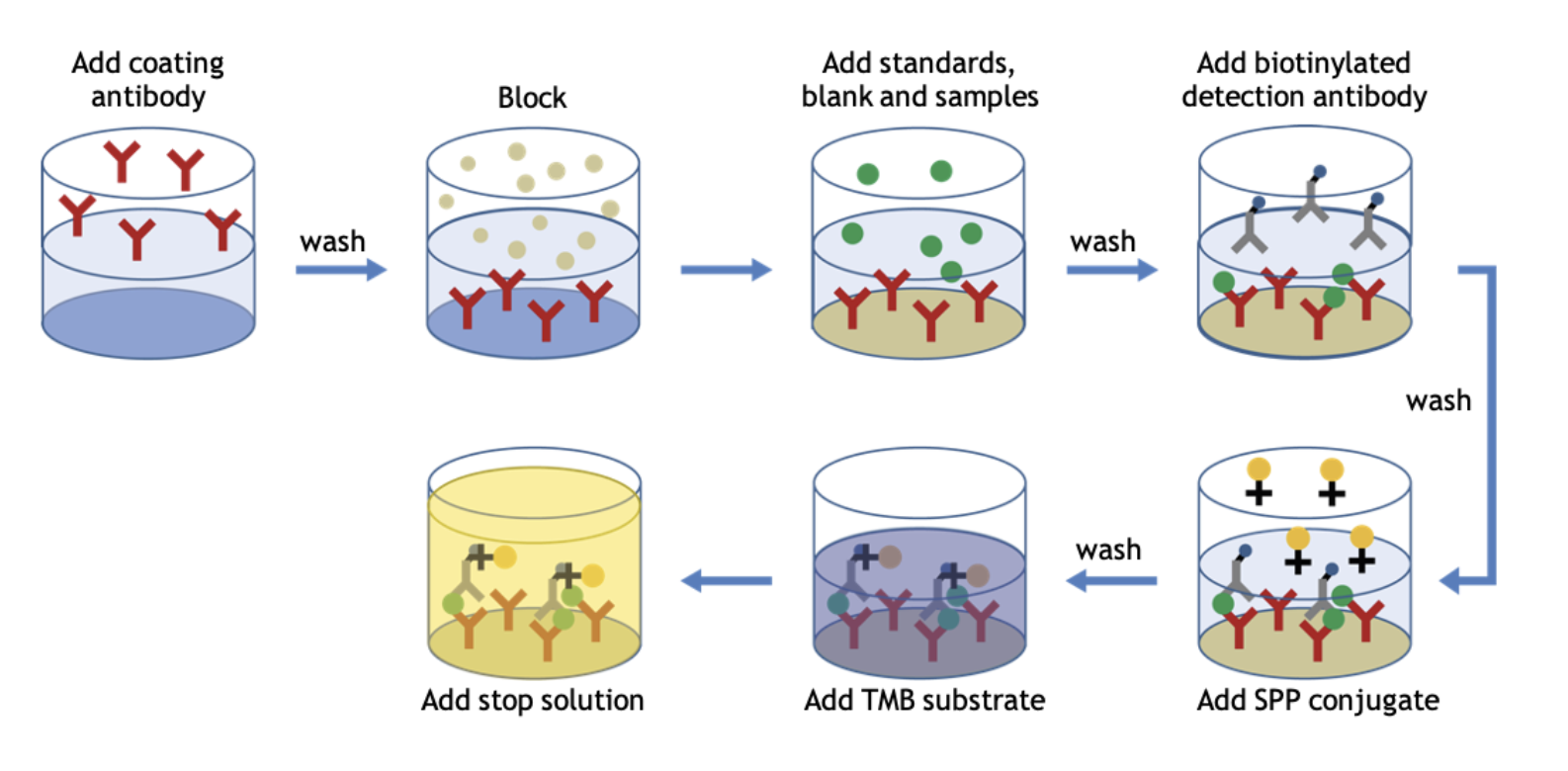 target protein to bind to the capture antibody.
3. A second biotinylated detection antibody binds to another site on the target protein, creating an "antibody-protein-antibody" sandwich.
4. HRP-labeled streptavidin binds to the biotin on the detection antibody.
5. An HRP substrate (such as TMB) is added, producing a color change proportional to the amount of target protein present.
6. The color intensity is measured and used to quantify the protein concentration.
U-CyTech’s ELISA products
We offer complete 5-plate ELISA kits and matched ELISA antibody pairs for 10-plate and 20-plate formats.
Our ELISA kits include all reagents required for up to 480 determinations, including optimized antibodies, standards, streptavidin-HRP conjugate, TMB substrate, buffers, and ELISA plates.
For larger-scale applications, matched antibody pairs are available for 960 or 1,920 determinations and include validated coating and detection antibodies, standards, and streptavidin-HRP conjugate. These antibody pairs are optimized to deliver the same reliable assay performance as our complete ELISA kits.
Do U-CyTech's ELISA kits contain pre-coated plates?
Our ELISA kits do not include pre-coated plates.
To ensure optimal assay performance, users should coat the ELISA plate(s) with the capture antibody one day before running the assay. This approach provides flexibility and allows the assay to be prepared according to the validated protocol included with the kit.
Do I need to optimize the coating and detection antibody concentrations?
Our ELISA products are supplied with pre-optimized coating and detection antibody concentrations, eliminating the need for additional assay optimization. For best results and consistent assay performance, simply follow the instructions provided in the ELISA manual (for kits) or the data sheet (for matched antibody pairs). This ensures reliable and reproducible protein quantification.
How should I store U-CyTech's ELISA products upon arrival?
Upon arrival, store all our ELISA kits and matched antibody pairs at 2 to 8 °C. For optimal long-term stability, we recommend storing the lyophilized streptavidin-HRP conjugate at -32 to -18 °C and protected from light.
Detailed storage instructions for individual reagents can be found in the ELISA manual (for kits) or data sheet (for antibody pairs). Following the recommended storage conditions helps ensure consistent assay performance and reagent stability.
For which type samples are the ELISA kits validated?
Most ELISA kits are validated for use with cell culture supernatants, serum, and plasma.
The specific sample types validated for each assay are listed in the corresponding product data sheet.
Can ELISA kits be used for non-validated sample types?
Our ELISA kits are routinely validated only for the sample types listed in the product data sheet.
However, this does not necessarily exclude their use with other sample types, such as tissue homogenates or other biological matrices.
If you plan to use a non-validated sample type, we recommend performing spike-and-recovery experiments to assess assay suitability and verify accurate analyte detection in your specific sample matrix.
What is the best method to store biological samples?
For optimal analyte stability, aliquot samples and store at -32 to -18 °C to prevent cytokine degradation.
Samples intended for analysis within 24 hours may be stored at 2 to 8 °C.
Avoid repeated freeze-thaw cycles, do not heat serum or plasma samples, and ensure frozen samples are fully thawed and mixed before analysis.
How many replicates should I test?
To ensure reliable and reproducible results, we recommend testing both standards and samples in duplicate at a minimum.
How many samples can be analyzed with one 5-plate ELISA kit?
A single 5-plate ELISA kit can be used to analyze up to 200 samples in duplicate. This estimate includes the required standard curve and blank wells on each plate.
What if I have limited sample volume?
For samples with limited availability, such as those from marmosets, mice, or rats, we recommend using a 384-well plate (Greiner bio-one, cat. no. 781061) instead of the standard 96-well plate. While the standard protocol uses 100 µl of diluted sample per well, a 384-well format requires only 20 µl per well, significantly reducing sample consumption. When using a 384-well plate, use 20 µl per well for all assay reagents and 50 µl per well for the blocking buffer.
Before switching formats, ensure that your plate reader is compatible with 384-well plates.
Why is sample dilution necessary in ELISA kits?
Sample dilution is recommended for two key reasons:
1. To bring analyte concentrations within the assay's measurement range. Many target proteins are present at levels higher than the ELISA's validated standard curve, so dilution helps ensure accurate quantification.
2. To reduce matrix interference. Biological samples such as serum or plasma contain components that can affect assay performance. Diluting the sample minimizes these effects and improves reliability.
How sensitive are the U-CyTech's ELISA kits?
The assay range of each ELISA kit is specified in the corresponding product data sheet and on our website. The assay range may vary between assays and reflects the lowest concentration of analyte that can be reliably detected under the recommended assay conditions.
For detailed assay range information, please consult the data sheet for your specific ELISA kit or visit the product page on our website.
How should coated ELISA plates be stored?
ELISA plates can be coated up to one week in advance and stored at 2 to 8 °C, provided they are sealed to prevent evaporation. For best results, coated wells should be washed and blocked using sterile wash and blocking buffers. The blocking buffer may remain in the wells until the assay is performed.
For longer-term storage, it is important to maintain sterile conditions for both the plates and reagents to preserve assay performance and reliability.
How critical are the incubation times and temperature?
Incubation times and temperatures are important for achieving optimal assay performance, accuracy, and reproducibility. For best results, follow the conditions specified in the ELISA manual, where room temperature is defined as 20 °C to 26 °C.
As an alternative, the blocking buffer, detection antibody, and streptavidin-HRP conjugate may be incubated overnight at 2 to 8 °C, providing additional flexibility while maintaining assay performance.
Is it possible to stack ELISA plates during reagent incubation?
We do not recommend stacking ELISA plates during reagent incubation. Stacking can cause temperature differences between plates and wells, which may affect assay consistency and lead to higher variability (CV values) in OD measurements.
For optimal and reproducible results, incubate plates individually under uniform conditions.
What about washing?
Proper washing is essential for accurate ELISA results. Incomplete washing can lead to higher background signals and reduced assay performance.
For preparation of the coating antibody solution and all washing procedures, do not use PBS tablets, as tablet excipients may interfere with antibody coating and assay performance. Instead, use sterile, ready-to-use liquid PBS. We recommend PBS (Thermo Fisher Scientific, Cat. No. 10010).
For each wash step, completely empty the wells, fill each well with at least 250 µl of freshly prepared wash buffer, incubate for 10 to 20 seconds, and then remove the buffer. Repeat this process at least six times. After the final wash, invert the plate and gently tap it on absorbent paper to remove any remaining liquid.
Why is the solution in the wells green after adding the stop solution?
A green color after adding the stop solution usually indicates that the substrate and stop solution have not mixed completely. Gently tap the plate to ensure thorough mixing. Once properly mixed, the solution should change to the expected yellow color before measuring the absorbance.
How do I plot the standard curve?
To generate a standard curve, calculate the average OD value for each standard and subtract the average blank OD.
Plot the corrected OD values against the corresponding standard concentrations and apply an appropriate curve fit.
For the most accurate quantification, we recommend using a 4-parameter (4PL) or 5-parameter (5PL) logistic curve fit, as ELISA standard curves are typically sigmoidal in shape.
Sample concentrations can then be determined by interpolating their corrected OD values from the standard curve.
Can I extend the standard curve?
Our ELISA kits are optimized and validated for the standard curve range specified in the product data sheet.
For the most reliable results, analyte concentrations should be measured within the linear portion of the curve.
While extending the standard curve may be possible for some assays, this should be validated by the user.
Samples with analyte levels above the assay range can be diluted to bring measurements within the ELISA's dynamic range and ensure accurate quantification.
My question is not listed here. How can I contact U-CyTech?
If you cannot find the answer to your question, our scientific team is happy to help.
With more than 25 years of experience developing and performing ELISAs for human, monkey, mouse, and rat samples, our researchers can provide expert advice and practical support.
For assistance, please contact our customer service team at cs@ucytech.com.