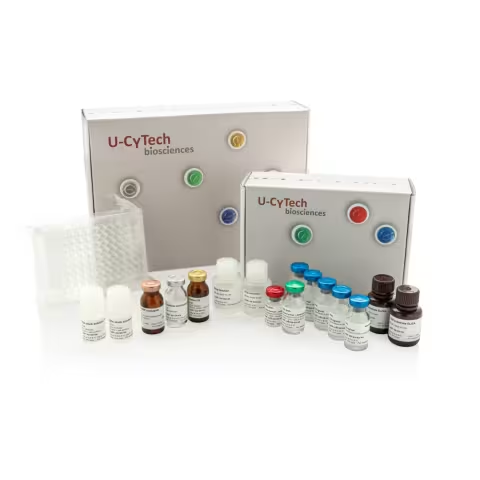
Human IL-6 ELISA kit - 5-plate
SKU
CT205A
All-inclusive ELISA kit with reagents and plates (480 determinations).
Format
5-plate
Price
€ 530
Documentation
Reactivity
Human
Category
ELISA
Analyte
IL-6
Range
2-128 pg/ml
Description
Our sandwich ELISA kits are developed for the determination of cytokines in culture supernatant, serum and plasma. Each kit includes all reagents required to perform up to 480 ELISA determinations: coating and detection antibodies, standards, streptavidin-HRP conjugate, TMB substrate, stop solution, cytokine stabilization buffer, BSA stock solution, ELISA plates and adhesive plate covers.
Analyte information
Description
Interleukin-6 (IL-6) is a multifunctional cytokine produced by a wide range of cells. These include innate immune cells as macrophages, dendritic cells, and mast cells, as well as B cells, and certain CD4 effector T helper (Th) cells. In addition, non-leukocyte cells such as endothelial cells, fibroblasts, astrocytes, epithelial cells can also produce IL-6.
Although IL-6 is well known for its strong pro-inflammatory effects, it also plays an important role in regulating adaptive immunity. Specifically, IL-6 influences the balance between different T helper cell subsets. It promotes the differentiation of Th2 cells by increasing the production of IL-4 and IL-13, while simultaneously reducing IFN-γ, which is typically associated with Th1 responses. Furthermore, IL-6 contributes to the differentiation of Th17 cells when acting in combination with TGF-β. At the same time, IL-6 can inhibit the activity of regulatory T (Treg) cells in vitro. Since TGF-β alone promotes Treg cell development, the presence of IL-6 is thought to shift the balance toward Th17 cell differentiation. In this way, IL-6 plays a key role in fine-tuning the equilibrium between pro-inflammatory Th17 cells and immunosuppressive Treg cells.
Although IL-6 is well known for its strong pro-inflammatory effects, it also plays an important role in regulating adaptive immunity. Specifically, IL-6 influences the balance between different T helper cell subsets. It promotes the differentiation of Th2 cells by increasing the production of IL-4 and IL-13, while simultaneously reducing IFN-γ, which is typically associated with Th1 responses. Furthermore, IL-6 contributes to the differentiation of Th17 cells when acting in combination with TGF-β. At the same time, IL-6 can inhibit the activity of regulatory T (Treg) cells in vitro. Since TGF-β alone promotes Treg cell development, the presence of IL-6 is thought to shift the balance toward Th17 cell differentiation. In this way, IL-6 plays a key role in fine-tuning the equilibrium between pro-inflammatory Th17 cells and immunosuppressive Treg cells.
Alternative names
IL-6, Interleukin 6, interleukin-6, IL6, IFN-beta 2, IFNB2, BSF-2, BSF2, HGF, HSF, CDF, BSF-2
Gene ID
Image